

The Human Algorithm: Leaders Making it Real | Culture & Capability | Part 1 of 8
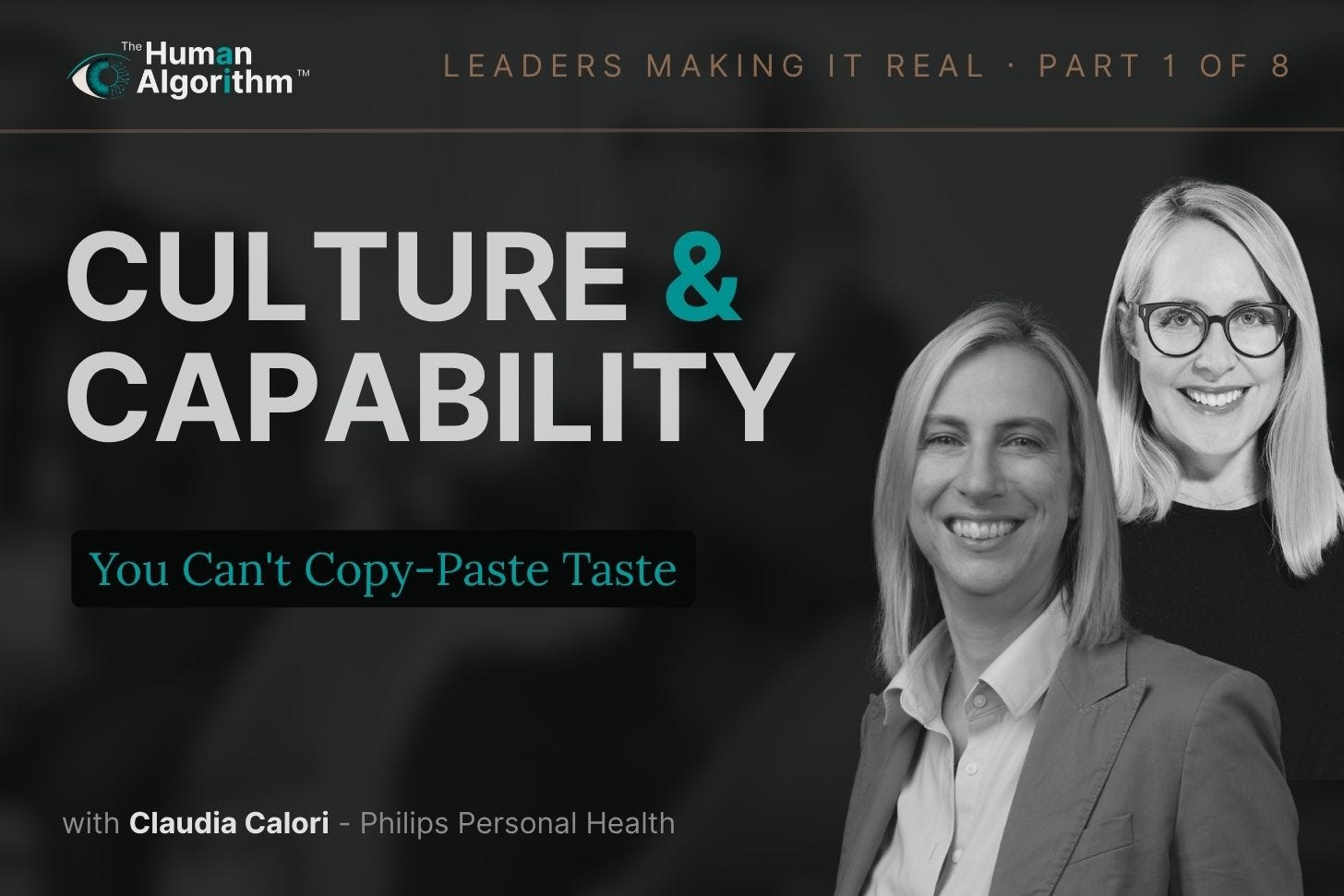
You Can't Copy-Paste Taste: Claudia Calori on why judgment—not tools—is the real AI differentiator.

At this point, most organizations aren’t struggling to access AI.
They’re struggling to absorb it.
I’ve seen teams with the right tools, licenses, even strong early experimentation—still unable to translate that into real capability. Not because the technology isn’t working. Because the organization hasn’t changed how work itself is defined.
That’s why we’re kicking off a new series, The Human Algorithm: Leaders Making It Real—a look at how senior leaders are translating human-centered AI from concept into practice inside real organizations.
If you’ve been following along, you’ll recognize the framework. Every people-first system is shaped by the same four forces: Culture & Capability, Tech with Intent, Design for Humans, and Trust as Infrastructure.
In this series, we turn that lens inward—away from finished products and toward the leaders building them. Not what the framework says, but what it looks like when it’s operationalized. Where it works. Where it breaks. And what leaders consistently underestimate.
We begin with Culture & Capability, and a leader who is actively reshaping how AI shows up inside one of the world’s leading consumer health organizations.
If you followed the last series, Signals from CES, you’re in the right place. If you’re just joining, welcome—you can catch up on earlier editions by subscribing below.
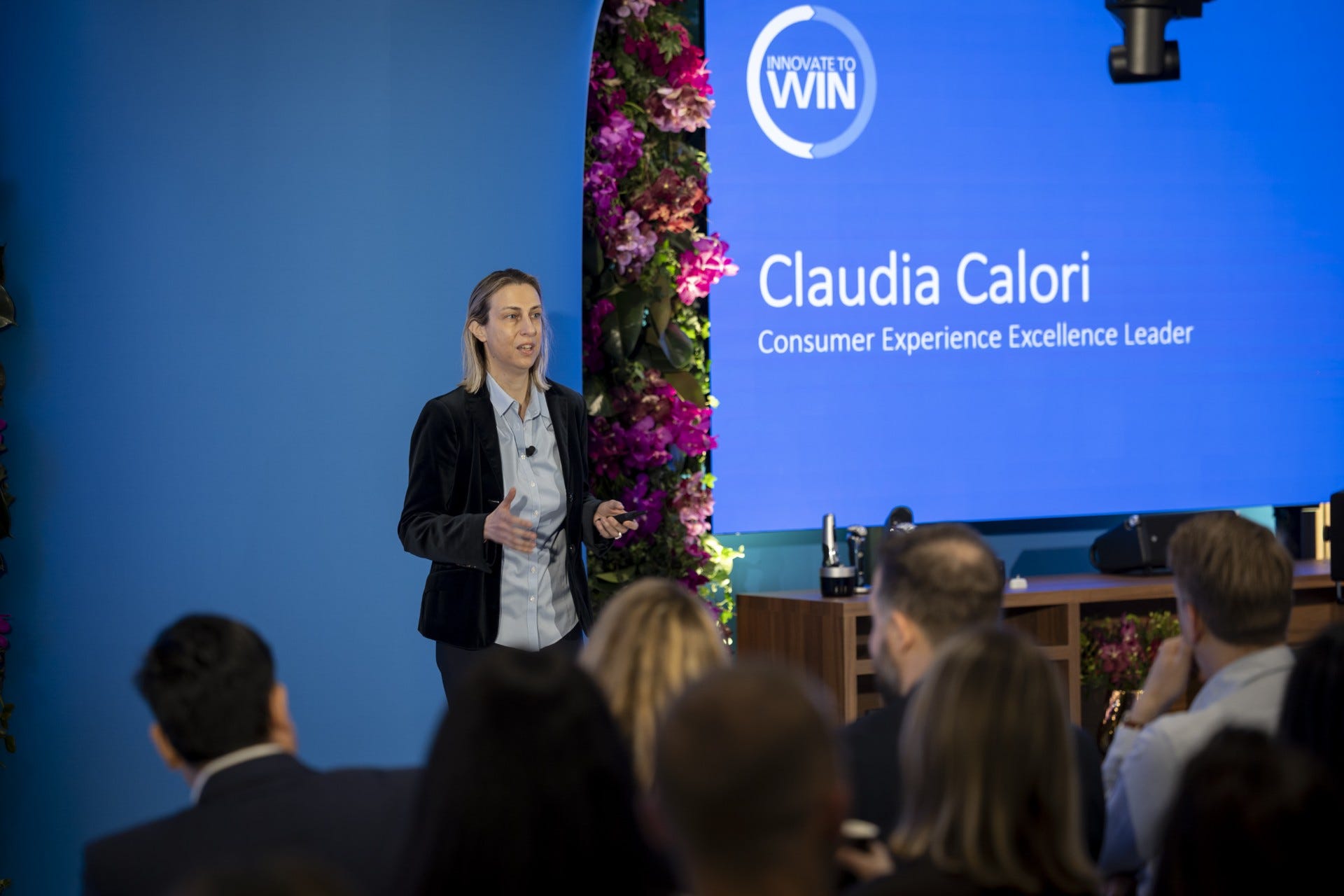
Meet Claudia Calori
VP of Marketing, Philips Personal Health · Adjunct Professor, LUISS Business School · Board Member, Eyes On The Future
Claudia Calori is a senior executive who has spent more than two decades building brands across industries most people never cross in a single career. After 10 years at Procter & Gamble, she moved to Heineken as Global Director for Desperados, then to Converse (part of Nike), and in 2019 joined Philips—first as General Manager for Garment Care, now as VP of Global Marketing for Personal Health, the consumer-facing division of the health technology company. She was recently nominated for European CMO of the Year.
She is an Adjunct Professor of Marketing at LUISS Business School in Rome and serves as a trustee and board member for Eyes On The Future, a UK non-profit advancing research into inherited retinal diseases.
She leads with a conviction that marketing is not a deliverables function—it’s the discipline closest to the customer. And in the age of AI, that distinction matters more than ever.
I asked Claudia how she’s building a marketing team that creates value with AI—not just adopt it. Here’s what she said.
What’s the biggest misconception leaders have about building AI capability & culture inside their companies?
The most pervasive misconception is that AI is a “plug-and-play” technology—something you can simply “paste” onto an existing organization to gain instant efficiency. I recently engaged on this topic with Elisa Farri, a Capgemini consultant and co-author of the HBR Guide to Generative AI for Managers. The point is: we must forget about the digital transformation of 10 years ago and realize this is totally different. This is about redefining the fundamental relationship between human and machine, and as a consequence, human work as we know it—processes, KPIs, ways of working.
If the organization’s immune system does not see this, it will reject the change. Real capability isn’t about enterprise licenses or how many people use tools daily or weekly. In a world where AI makes average output infinite and virtually costless, the critical value is the human ability to discern “great” from “mediocre”—a quality I’d call “taste.” You can’t “paste” taste. You have to build the culture that prioritizes it.
Where do organizations—especially marketing teams—struggle most when building AI capability?
Marketing organizations are caught in what I call the “Efficiency Trap.” This happens when we view marketing primarily as a series of deliverables: videos, social posts, landing pages. If that is your lens, AI is just a cost-cutting tool to drive down cost-per-asset. But this leads to a race to the bottom of generic content.
Marketing is the art and science of understanding real people’s real problems, to then solve them. In an AI-driven consumer journey, people—and their AI agents—aren’t looking for more noise. They are looking for clear, trustworthy solutions to their problems. If we marketers don’t use AI to encode deeper meaning and original signals into our brands, we are simply using technology to accelerate our own irrelevance.
My friend Thomas Marzano calls it the Legible-Lovable Brand Law: a brand must be structurally legible to machines to be surfaced, and emotionally lovable to humans to be chosen. For a marketer, the opportunity is to create a brand loved by humans and read by machines.
What does “good” AI application look like in practice?
“Good” looks like moving from “AI as a tool” to “AI as a teammate.” This past March at Philips Personal Health, we organized a hackathon to systematize 68,000 knowledge articles—a massive data architecture task that traditionally would have required a year of manual labor. We created an “AI Clean-up Buddy.” What changed from the “old” hackathon setup was the seating chart: AI was invited to the table as a co-worker, not just a backend solution.
We distilled those 68,000 articles down to 3,500 high-quality pieces in just a few hours. And beyond the speed, the real success was the live feedback loop. The team sat with the AI, iterating in real time, applying their “taste” to the machine’s scale. When the team sees AI as an “intern at scale” rather than a replacement, the culture shifts from fear to craft.
What’s the hardest decision you’ve had to navigate regarding AI literacy and fluency?
The hardest decision is to accept “Literacy Inversion.” In most corporate structures, you train the bottom of the pyramid and simply “brief” the top. To build true capability in AI, we had to flip that model. We have a strong program—our AI Academy—for the broader organization. But in parallel, our most senior, most “expensive” talent now spends hours in the weeds of an LLM.
If leaders lack tactical fluency, they become unable to judge the quality of the work being produced. You cannot lead an augmented organization if you don’t understand how it augments you first.
To enable their teams to be AI-ready, where should marketing leaders start?
I would tell them: “Don’t hire a consultant to train your team. Hire one to train YOU.”
Leaders must resist “Cognitive Delegation,” the dangerous temptation to outsource their thinking and strategy to the machine or to external agencies.
Spend a good portion of your week using these tools to do your own specific job, writing your documents, analyzing your budgets, or brainstorming your strategy. As Elisa Farri notes, the manager must become a collaborator. Once you have personally felt both the “magic” and the “hallucinations,” you can lead from a place of lived experience. Focus on your own augmentation before you attempt to automate anyone else’s.
What’s one question every leader should ask right now?
Am I merely “briefed” on AI—or am I actually “trained” in it?
“You cannot lead an augmented organization if you don’t understand how it augments you first.” —Claudia Calori
My take
Claudia’s interview lands on the skill I believe will define this next era: judgment.
As output becomes abundant and inexpensive, the advantage shifts to leaders who can recognize what matters and build organizations that reinforce that standard. The tools will keep getting better. The real question is whether leadership has the fluency to direct them, and the culture to sustain quality when everything can be produced at scale.
You can scale tools. You cannot scale taste without culture.
Make the Human Algorithm real
Look at your leadership team. Not your roadmap. Not your tools.
Start with one question: Where are we still treating AI as something to oversee—instead of something to practice?
Pick one piece of your own work this week. Use AI directly. Not to delegate your thinking. But to sharpen it. Capability doesn’t scale through rollout. It builds through practice—starting with leadership.
What’s next
This is Part 1 of The Human Algorithm: Leaders Making It Real.
In the next issue, we shift to Tech with Intent—exploring what it looks like when technology is designed not just to scale, but to serve a clear purpose inside the organization. Because frameworks don’t fail in theory. They fail—or succeed—in execution.
We can’t slow the pace of change, but we can choose how we lead through it.
Culture & Capability reminds us that the organizations that scale AI are the ones that first build the judgment to use it.
Let’s shape what’s next, together.
— Alyssa
The Human Algorithm is where I explore AI-enabled, human-centered growth for leaders building what’s next. Subscribe on Substack for the series and connect on LinkedIn to stay in the conversation.
Live & upcoming
StaffBase VOICES Americas 2026: Virtual · May 12 · Keynote: Beyond the Rollout: Designing AI that Delivers
NEXT Pharma Summit 2026: Dubrovnik, Croatia · May 20 · Keynote: The Era After Efficiency: Redesigning Work for Human-AI Performance
Register through the links above. Would love to see you there.
Love this collaboration 🙏🙌 there's so much to unpacked! Well done Claudia and Alysaa
So many points resonated in this interview with Claudia Calori, VP Global Marketing at Philips Personal Health, about building AI into marketing organizations.... this is a favorite: "You cannot lead an augmented organization if you don't know how it augments you first."