

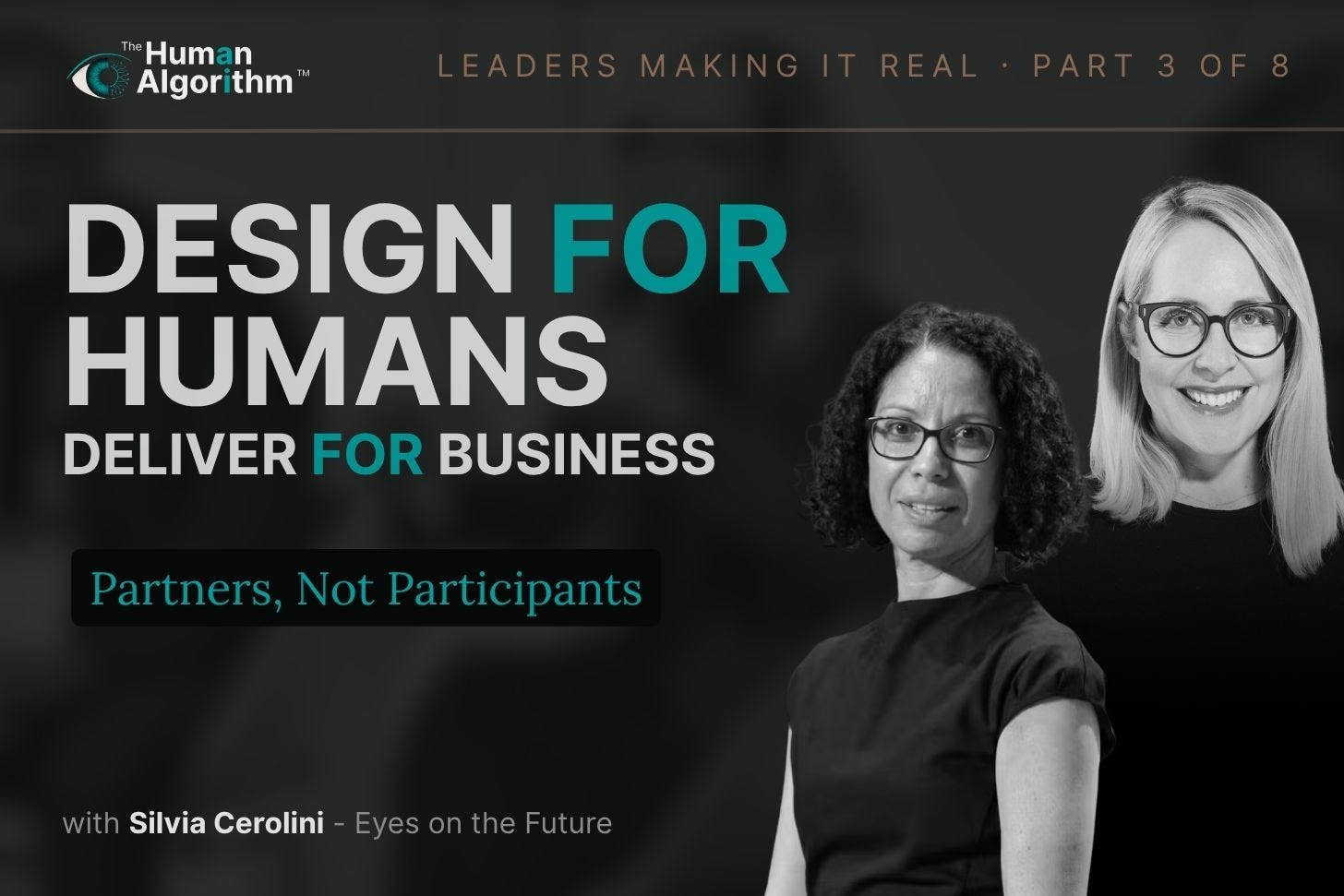
The Human Algorithm: Leaders Making It Real | Design for Humans, Deliver for Business | Part 3 of 8
Partners, Not Participants: Silvia Cerolini on why AI and patient partnership—not process—are rewriting the future of healthcare innovation.

The language of human-centered design is everywhere. The practice isn’t.
I’ve watched the pattern across industries. A product team builds a “user-centered” roadmap from survey data alone. A healthcare system launches a “patient-first” initiative that patients never helped shape. A company trains an AI tool on the people it’s meant to serve, using engineers who don’t look or live like them. Design becomes something done to users, not with them.
This is Part 3 of a new series, The Human Algorithm: Leaders Making It Real. A look at how senior leaders are translating human-centered AI from concept into practice inside real organizations.
In the last issue, Vivek Chaudhri showed us that Tech with Intent is all about the work everyone wants to skip: the operational rewiring, accountability, and connection to strategic outcomes.
Design for Humans, Deliver for Business is the driver most organizations claim and few actually deliver. In this issue, we sit with a leader who works both sides—inside one of the world's largest pharmaceutical companies, and alongside the patients it's meant to serve.
If you’ve been following The Human Algorithm, you’ll recognize the four drivers that shape people-first AI transformation: Culture & Capability, Tech with Intent, Design for Humans, and Trust as Infrastructure. If you’re just joining, welcome—you can catch up on earlier editions by subscribing below.
Meet Silvia Cerolini
Founder & CEO, Eyes on the Future · Head of Transformation, Sanofi UK & Ireland · Health Executive in Residence, UCL Global Business School
Silvia Cerolini is an innovation and transformation executive who has turned insights, data, and digital into business outcomes across both consumer goods and pharmaceuticals. She built her foundation over sixteen years at Procter & Gamble, rising to Group Director, Analytics and Insights. In 2022, she moved into healthcare, joining Sanofi, where she is Head of Transformation for UK & Ireland with AI at the heart of her cross-business unit scope.
She is the founder and CEO of Eyes On The Future, a nonprofit she launched in 2018 to accelerate treatments for ultra-rare childhood blindness—now a community of families across more than twenty countries, with over $5 million raised for research. She also serves as a Health Executive in Residence at UCL Global Business School for Health, the first business school dedicated to health.
Her work challenges a long-standing assumption in healthcare: that patients are participants in the system, not partners in shaping it.
I asked Silvia what it takes to design systems that truly reflect human needs while still meeting business goals. Here’s what she said.
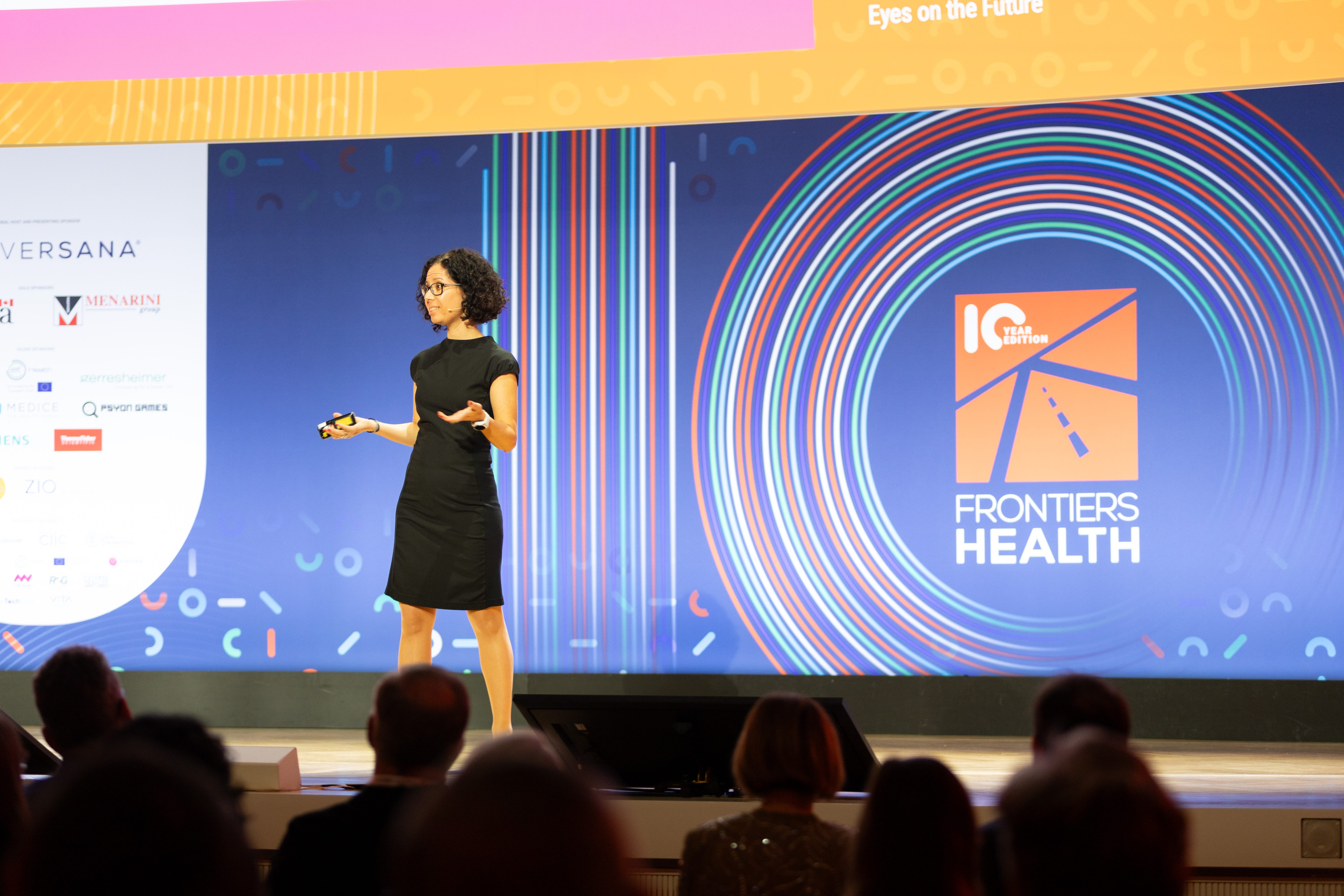
What’s the biggest misconception leaders have about designing for humans while still delivering results?
The biggest misconception is that patients are just patients. Subjects to recruit for clinical trials and final users of the products.
For me, human-centered design is true patient partnership. It means involving patients in real decisions across the full pathway, from clinical development to endpoints, to defining what value really means, and engaging with regulators.
Patients today are informed, connected, and organized. They can influence priorities, challenge assumptions, and accelerate progress.
The industry now has an opportunity to evolve. Drug development is still too long and expensive, many populations such as rare diseases are left behind, and we are not fully capitalizing on scientific progress.
What is different today is the combination of AI and patient partnership. AI brings scale and speed in how we understand data and make decisions. Patients bring real-world context and urgency. Together, they can challenge how things have always been done and drive more fundamental change.
Where do organizations struggle most when it comes to putting humans at the center of innovation?
The biggest struggle is moving beyond incremental change.
Healthcare systems have been built over many years and were designed for large populations and standardized approaches. That is understandable given their complexity, but it also limits progress. Most organizations are still optimizing existing models rather than rethinking them.
What is changing now is the combination of AI and patient perspective. AI enables new ways to design studies, analyze data, and make decisions earlier. Patients bring clarity on what outcomes matter, what trade-offs are acceptable, and where effort should be focused.
They also help align perspectives across stakeholders because they sit across the entire journey.
Together, this creates a real opportunity to redesign parts of the system, not just improve them.
What does “good” design look like in practice?
Good looks like building new models, not just improving existing ones.
This is very personal for me. When I was looking for a treatment for my daughter, I was often told, “come back when we have a cure.” That mindset assumes patients wait. In reality, patients can actively shape progress.
Through Eyes on the Future, we are working as partners with biotech, researchers, regulators, and families to shape the full development pathway. This is grounded in four areas:
Patient leadership: we as patients bring urgency and are directly involved in governance and key decisions, helping set priorities and keep focus on what truly matters
Diversified financing: we are directly funding clinical development, mobilizing our communities, and partnering with industry to de-risk and accelerate programs
Efficiency: we actively challenge unnecessary steps, streamline pathways, and push to focus only on what truly matters to move faster
Innovation: we are driving the use of AI and real-world data to improve decisions, accelerate development, and shape more adaptive regulatory pathways
Concretely, this means influencing endpoints so they reflect meaningful impact in daily life, shaping trial approaches to make them more feasible and targeted, and bringing stakeholders together earlier to avoid delays.
The ambition is to create a blueprint for a more collaborative and effective model, starting with rare diseases but applicable to a more personalized future of medicine.
What's the hardest decision you've had to navigate regarding what’s right for the patient vs. the business?
One of the hardest challenges is working within a system that has been built around large patient populations.
When you are trying to develop new models, especially in rare diseases, many assumptions do not hold. Evidence requirements, timelines, and investment models are all designed for scale.
At the same time, science is moving toward more personalized approaches, where we will increasingly deal with smaller and more defined patient groups, including in areas like cancer.
This creates a gap. We are applying old models to a new reality.
Closing that gap requires rethinking discovery, development, and commercialization. It also means making decisions without having all the answers and sometimes moving forward without fitting existing frameworks.
To enable human-centered innovation, where should leaders start?
Start by asking a simple question: how can I do this faster and better for patients?
In practice, combining patient partnership with AI can make an immediate difference. Patient partnership helps define what matters most and where effort should be focused. AI helps act on that by identifying patients earlier, accelerating pathways to diagnosis and care, and improving how decisions are made across development and delivery.
It also changes how we develop medicines. The use of digital twins, in silico models, and real-world data can make trials more targeted, reduce unnecessary burden, and support faster, better-informed decisions.
The opportunity is not to add layers to the system, but to build a smarter one that gets the right innovation to patients more quickly and more efficiently.
What’s one question every leader should ask right now?
Am I operating within the current rules of the game, or am I changing them?
Science is moving fast. Development and business models are lagging behind. Patients are waiting.
We need to play a different game.
“We are applying old models to a new reality.” —Silvia Cerolini
My take
Silvia’s interview surfaces a tension I’m seeing across every industry, not just pharma.
The word “human-centered” has lost its weight.
Everyone's claiming it. Few are building for it.
Real human-centered design is structural. The people you're designing for shape the work, guide governance, and define what "success" means before the model gets built. Not input. Ownership.
AI makes this shift more possible. It lets us listen at scale, include voices we used to exclude, and turn partnership into something operational.
But it doesn’t drive it. People do.
And when ownership shifts, the business outcomes follow.
Make the Human Algorithm real
Look at one initiative your team is building right now. Then ask about the people it’s meant to serve:
Are they shaping the work?
Are they guiding governance?
Did they define what good looks like before you started?
Because designing for humans isn’t about inputs and insights alone. It’s about ownership. And ownership changes everything.
What’s next
This is Part 3 of The Human Algorithm: Leaders Making It Real.
In the next issue, we move to Trust as Infrastructure—exploring what it takes to design systems that people don’t just use, but rely on. Because as AI becomes more embedded in decisions, trust is no longer a feature. It’s a requirement.
We can’t slow the pace of change, but we can choose how we embrace it.
Design for Humans, Deliver for Business shows us what happens when we build with people instead of for them. Better products. Better outcomes. Better business.
Let’s lead differently.
— Alyssa
The Human Algorithm is where I explore AI-enabled, human-centered growth for leaders building what’s next. Subscribe on Substack for the series and connect on LinkedIn to stay in the conversation.
Live & upcoming
NEXT Pharma Summit 2026: Dubrovnik, Croatia · May 20 · Keynote: The Era After Efficiency: Redesigning Work for Human-AI Performance
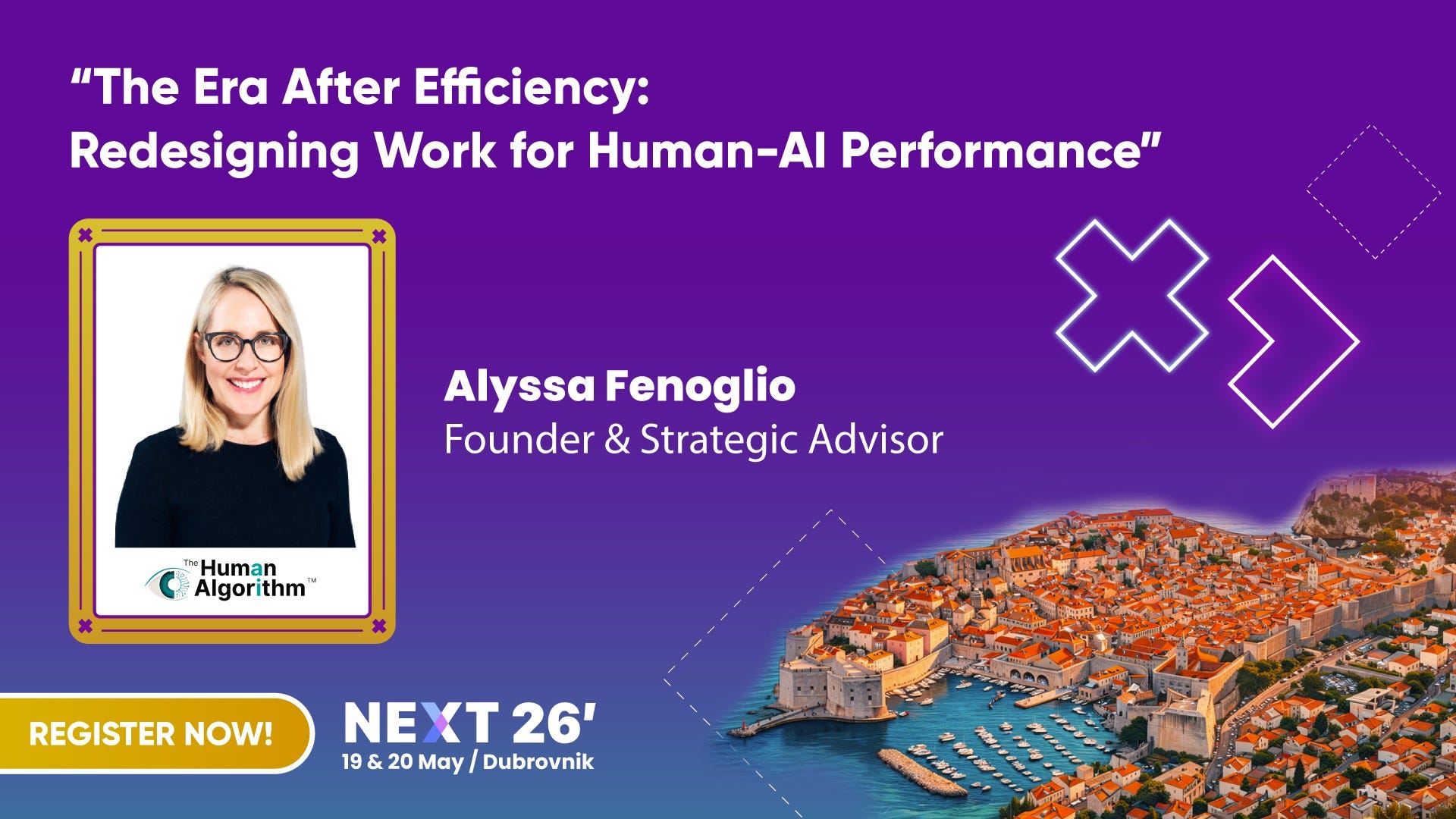
Register through the link above. Would love to see you there.