

The Human Algorithm: Leaders Making It Real | Trust as Infrastructure | Part 4 of 8
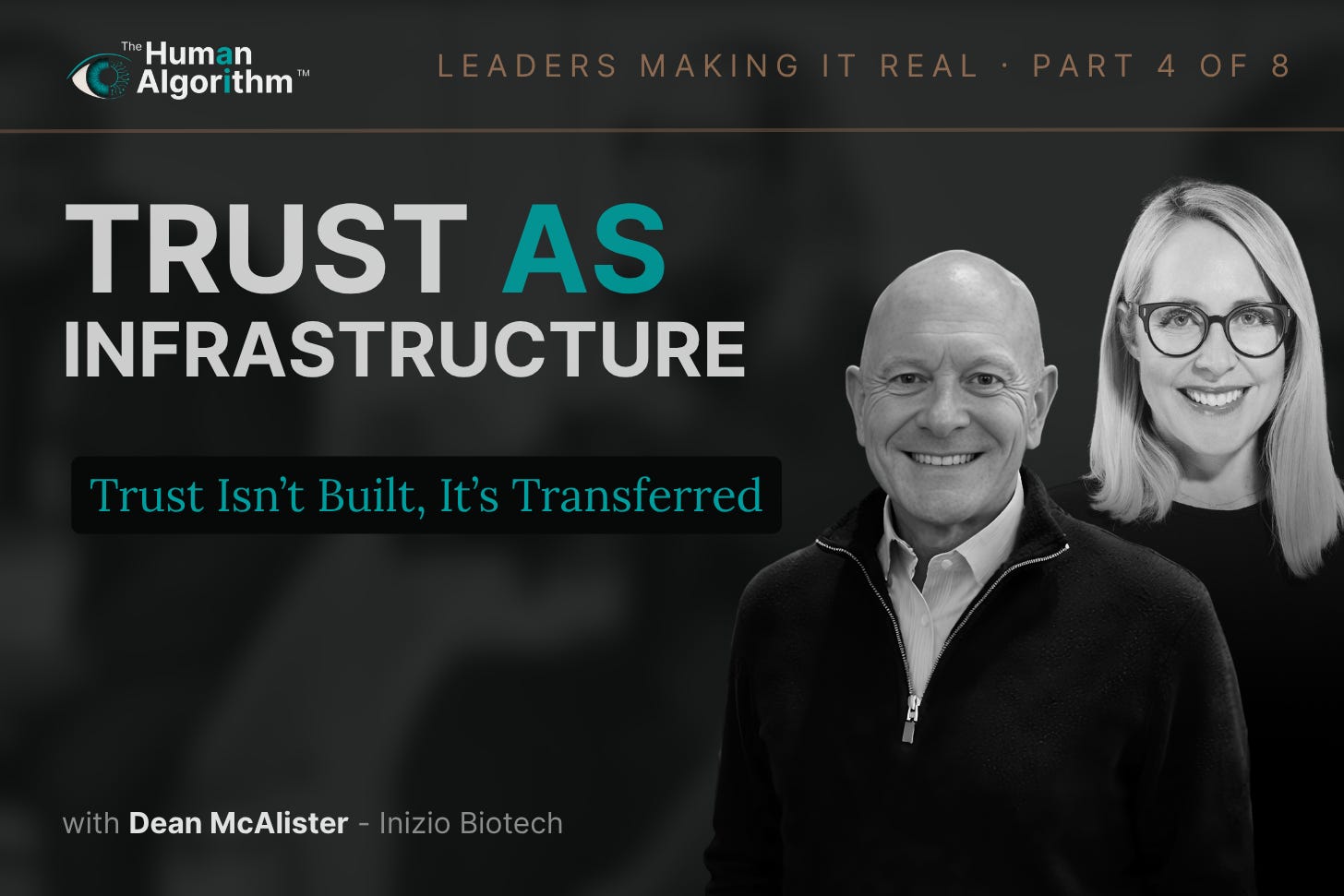
Trust Isn’t Built, It’s Transferred: Dean McAlister on why AI's trust problem isn't a gap to close—it's equity to transfer.

There is a real trust problem around AI.
Customers don’t fully trust how companies will use it. And the tech industry is facing public scrutiny for their role in driving this massive change moment in society.
Most companies are asking the obvious question: how do we build trust with our employees and customers with AI?
There’s a better place to start.
This is Part 4 of The Human Algorithm: Leaders Making It Real, where the people-first transformation framework shows up in practice. Four drivers. Eight leaders. Two rounds.
In the last issue, Silvia Cerolini showed us that Design for Humans, Deliver for Business is about partnership not process—the path to genuine ownership and improved outcomes.
Round 1 closes here with Trust as Infrastructure, the driver the other three depend on. And a leader who has led thousands of people at the top of one of the most trust-dependent industries on the planet.
Across The Human Algorithm, we’ve explored four drivers that shape people-first AI transformation: Culture & Capability, Tech with Intent, Design for Humans, and Trust as Infrastructure. If you’re just joining, welcome—you can catch up on earlier editions by subscribing below.
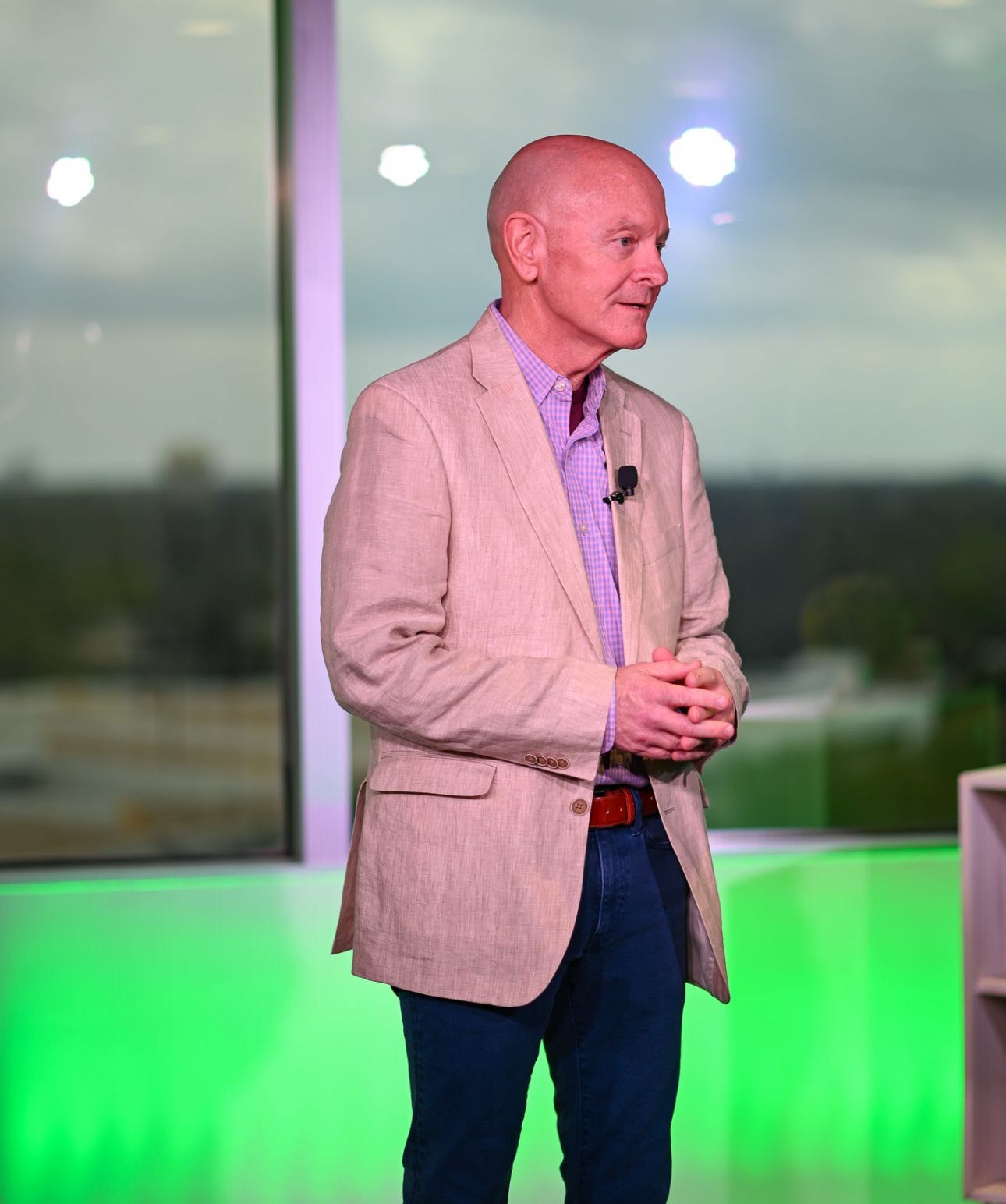
Meet Dean McAlister
Executive Vice President, Inizio Biotech · Former AstraZeneca Commercial Executive · Board Member, AdhereTech
Dean McAlister has spent nearly four decades on the commercial frontlines of Fortune 500 pharma—leading national and regional sales organizations, building cross-functional teams across multiple therapeutic areas, and running strategic business development from launch through scale.
He spent close to three decades at AstraZeneca in senior commercial and market access roles, rising to Executive Business Director, Respiratory. From there, Dean moved into executive leadership at consulting firm, Inizio Biotech, and today serves as Executive Vice President.
He also advises AdhereTech as a Board Member and speaks, trains, and writes on organizational leadership and what it takes to build sustainable, scalable teams.
Dean treats trust as equity. Something that accrues over time, carries a shelf life, and compounds—or erodes—with every decision a leader makes.
I asked Dean how leaders should think about trust in the age of AI. Here’s what he said.
The views expressed here are Dean’s own and do not represent those of his employer.
What’s the biggest misconception leaders have about the role of trust in AI transformation?
Presuming that mistrust is the biggest gap. When people start talking about something that’s a mystery black box, there’s a portion of the population—and I’m in it—that doesn’t look at it as bad. I look at it as great. I wish I would have had this years ago. You minimize where you can go with your organization by presuming mistrust.
I would almost rather presume trust—like we’re all presumed innocent till proven guilty. No angst and wasted organizational effort trying to move people from mistrust to trust. I would rather presume trust first.
I had a boss who said everyone starts out with a minus 5 on trust. What a glass-half-empty way to look at life. It would drain me like an energy vampire to mistrust every new person I meet. I would rather go in with a degree of trust and then you lose points—instead of mistrust and you gain points.
Where do organizations struggle most when building trust into their initiatives?
They think they can’t go in with the equity they already have from other things they’ve done. Look at the GLP-1 area right now—it’s such a part of the consumer dialogue. HCPs and other constituents are exposed to where Eli Lilly (Lilly) has gone as an organization.
They brought a medication to market that they thought enough of to do competitive trials against the comparator from the beginning—and they beat them. They’ve shown how you can build scale and build trust. They have an equity base because of other things they’ve built, and you need to borrow from that equity as you’re bringing in a new idea—whatever the new idea is.
All that equity can transfer over, often without a lot of effort. So when we’re bringing a new AI or digital idea, we say: these are the same people who brought you that highly efficacious solution. It’s the premise of borrowing equity from something that’s already worked. That’s the big idea.
What does “good” trust look like in practice?
Those are usually best borne out in moments of crisis. How is an organization reacting when things fell apart? Johnson & Johnson (J&J) is not a perfect organization by any stretch—read No More Tears and you’ll understand that. But going back to the Tylenol issues in the 80s, when there was tampering, they pulled everything off the shelf and put in safety measures. They acted quickly, decisively, ethically responsibly. You could argue they did it to preserve liability. I say they acted expeditiously. Data breaches are the same—the ones that managed it well came back to stakeholders and said here’s what happened, here’s why.
A more recent digital example is LillyDirect. 50% of that volume is now going through LillyDirect. Even though there’s insurance enablement on a lot of it, it’s a trust aspect that’s direct.
They’re borrowing the good name Lilly has built in diabetes from 100 years ago. The first time I went to Lilly in Indianapolis, the downtown location has a museum in the lobby about their work with insulin and how it all came about. Fast forward 100 years, and now a patient can press the button that says I want the prescription filled now. You trusted us with insulin. Now you trust us with something as personal as what you weigh. That's the big lesson: capitalize on the equity you already have.
Companies that want trust in digital enablement have to take out layers of intermediaries. Take out the pain points—there will be new ones, but it’s like closing on a house. How many more documents do I have to DocuSign? Once you’re in, sitting there one night watching Wheel of Fortune, you’re thinking: I like this place. The juice was worth the squeeze.
What’s the hardest decision you’ve had to navigate regarding the balance between trust and speed?
I don’t have a problem moving fast. I firmly believe there are enough human speed bumps in life that will slow you down. If you move fast enough, somebody will tell you if you’re about to pull a Thelma and Louise going off the cliff—they’ll say, the road’s out up there, you really should stop.
I’ve gone through a trust moment with my own employer. I said to our CEO: I am going to leave here at the end of the year. I've pioneered something that didn't exist before. I’m giving you a nine-month notice. I am not staying one extra day. That’s trust built over time—he means what he says, and he’s been consistent.
Everybody has a shelf life. Go to your Kroger or your King Soopers—there’s a milk carton with a best-if-used-by date on it. Your trust equity goes down if you go past your shelf life. I’m a hero right now. One day I’ll be past my prime. That’s when you reinvent.
You don’t reinvent well in crisis. If I were in one of these AI-enabled companies riding the wave, I’d be reinventing as fast as possible while I’m on top of my game. Look at Lilly. Here’s what their oral therapy is going to do and how it’s better than Novo Nordisk’s (Novo) oral therapy, Wegovy. They’ve produced, at risk, a billion dollars worth of tablets at their manufacturing site in Puerto Rico. That’s how confident they are. They’ve come out with their triple therapy at bariatric surgery levels. It’s no longer about the weight drop. Now it’s about the maintenance. They’re redefining the terms before a moment of crisis.
Opposite of that, Novo. They were king of the hill—2024 GDP was rocking Denmark. On a tour like I did in June of 2024, the guide—who had nothing to do with pharma and didn’t even know what I did for a living—talked about Novo Nordisk on a tour of Copenhagen. I came here to get away from work, I thought. That’s how prominent they were. Look where they are today. They didn’t reinvent when they were on top of their game. I’m doing it personally. Companies have to do it at scale.
To enable a trust foundation, where should leaders start?
I would start with how clear you’ve been on what you want to be known for—not the job you’re in, but what you’ve been known for. What innovative things have you brought over the past five to 10 years that were equally innovative as AI and digital strategy is today? You have to borrow from that equity. Prior results are predictors of future performance.
Much like when we introduced product X into channel Y—remember that time? Remember how proud we all were of those professional moments we created? We can recreate that anytime we choose. See how I borrowed from the past to fuel the future—and enrolled the person, so it stopped being I and started being we.
It has to go back to the way I look at things: value, vision, strategy, tactics—in that order. I always anchor it back to a value. When Paul Hudson was my upline boss at AstraZeneca, he came in and said, “we’re going to follow the science and we’re going to play to win.” That was his playbook. Anything put forward as an initiative, he anchored back to that value. I got the line of sight. That value led to the vision, then the strategy, then the tactics.
People see and hear AI and think, this is flavor of the month. It’s going to fall flat unless you anchor it back to the value, the vision, the strategy, then the tactic.
The other thing: people don’t have a refractory period. Don’t immediately go to the next thing. Let the AI and digital work settle. Talk about the same things over and over so you can help people focus, inspire, decide, and codify. Otherwise, no one can follow all the pivots.
A leader needs to be a thermostat leader, not a thermometer leader. A thermometer leader reflects the ambient around them. The thermostat leader changes the temperature and says: I’m going to hold this on my shoulders, and you, as my downline leader, go execute. I’ve got your back.
What’s one question every leader should ask right now?
What’s the one question I’m afraid somebody is too afraid to ask when I talk about this? Am I going to lose my job? That’s what everybody wants to know. Don’t look at it that way. Look at it as glass half full—on offense.
I have to go in a given day across probably 10 or 12 different therapeutic areas. There’s no way I can prepare to the degree I’d like to. AI has enabled me to be conversant as I go through my day. I just have to be able to talk about anything for five minutes and nothing for six. With a simple query, I can be prepared on something that used to take 30 to 45 minutes. I can now do that in five. I’m more effective in my job than I’ve ever been.
It’s deep change or slow death, and that’s up to the individual. I’m going to be all over deep change. I have reinvented more times than a chameleon across my career. AI is not the first thing I’ve seen come along—I saw omnichannel, multi-channel marketing, and before that, writing up calls in triplicate with the goldenrod copy going to sales training. It’s the same thing now, just a different set of facts. If you have a reinvention mindset—and you reinvent while on top of your game instead of in crisis—you never get to the point where you worry about it.
It always goes back to: what do you want to be known for? I want to be known for growing leaders and delivering results. To do that, I have to be 100% of who I am and 0% of who I’m not. I lean on my top five strengths and pick one to overindex on. And Maximizer loves AI. Loves AI. My gosh, it’s a gift.
“I would rather go in with a degree of trust and then you lose points—instead of mistrust and you gain points."
— Dean McAlister
My take
Dean’s interview puts a spotlight on a growing reality.
AI is going to amplify whatever trust you have—and reveal whatever you haven’t.
That’s the pattern I see playing out across industries. Leaders who’ve spent years investing in trust with their teams, their customers, and their partners are finding that AI magnifies that advantage. They move faster. They experiment more openly. They recover quicker when things go sideways.
The ones who haven’t? AI can’t manufacture it. It just reveals whatever’s already there.
That’s why the advantage in this next chapter isn’t in the size of the AI investment or the speed of the rollout. It’s in the quality of what you already built before AI walked in the door.
AI is a multiplier, not a maker.
What you’ve done to earn trust, long before this moment, is about to matter more than ever.
Make the Human Algorithm real
Before you build trust in AI, look at the trust you already have.
An honest gut check: across your team, your brand, and your organization.
Ask:
Where are we starting from mistrust instead of trust?
What existing credibility are we not using?
Where is friction breaking trust in the experience?
Because trust isn’t something you layer on top. It’s the foundation everything else runs on.
What’s next
This is Part 4 of The Human Algorithm: Leaders Making It Real—and the close of Round 1.
Across these four issues we’ve explored what it takes to turn AI from concept into capability: Culture & Capability with Claudia Calori, Tech with Intent with Vivek Chaudhri, Design for Humans, Deliver for Business with Silvia Cerolini, and Trust as Infrastructure with Dean McAlister.
In two weeks, Round 2 begins. Same four drivers. Four new leaders. New lenses on what it looks like when AI becomes real inside organizations.
Before we jump in, one ask: which of the four drivers hit hardest for you: Culture & Capability, Tech with Intent, Design for Humans, or Trust as Infrastructure? Drop your answer in the comments. I’m using what you share to shape where Round 2 goes next.
We can’t slow the pace of change, but we can keep learning from the leaders already making it real.
Trust as Infrastructure reminds us that the trust AI needs is the trust you’ve already earned.
Let’s shape what’s next with trust.
— Alyssa
The Human Algorithm is where I explore AI-enabled, human-centered growth for leaders building what’s next. Subscribe on Substack for the series and connect on LinkedIn to stay in the conversation.
This is one of my favorite takes! (Not biased at all) It's great to hear a different perspective of how AI leverage or Errodes trust.
Dean shared some brilliant leadership trust lessons relevant to any new transformation. I love his view on view trust as something that compounds over time, it can never be ignored in the short or long term.