
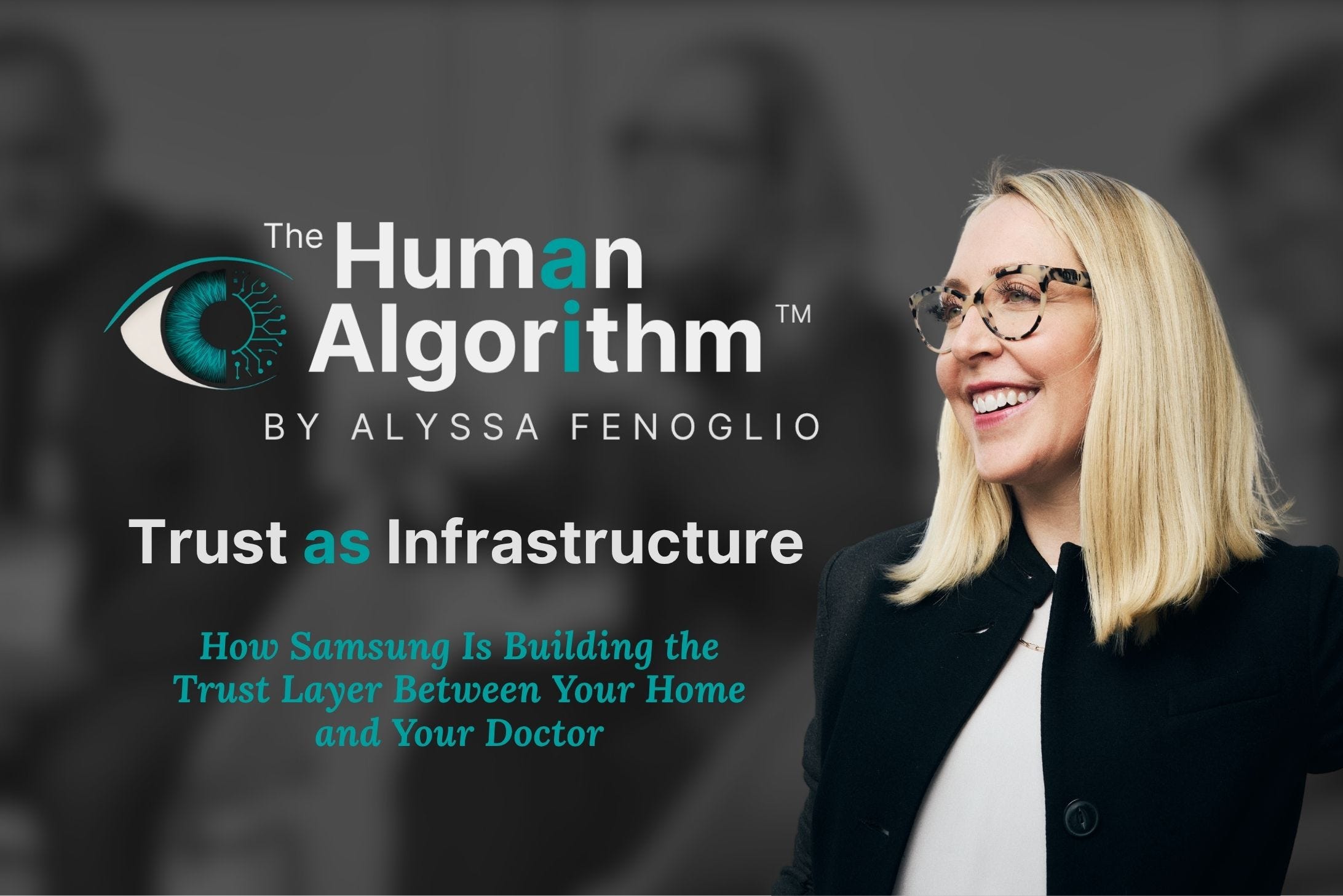
Trust as Infrastructure
How Samsung Is Building the Trust Layer Between Your Home and Your Doctor

If you’ve ever navigated the U.S. healthcare system, you know how quickly things fall apart. I recently spent ten hours coordinating a routine breast cancer screening across five different platforms—none of them connected, no one owning the process, and no clear answer on cost. At one point, flying to Paris and paying cash felt like the rational option. The technology existed. The trust layer connecting it didn’t.
Samsung isn’t the obvious company you’d expect to lead here. But at CES 2026, it showed something that stayed with me—not because of what it can do today, but because of what it’s asking us to trust next.
Welcome back to The Human Algorithm: Signals from CES—a four-part series exploring the standout products that cut through the noise and what they teach us about designing technology that fits seamlessly into how people live.
Every people-first system is shaped by four forces: Culture & Capability, Tech with Intent, Design for Humans, and Trust as Infrastructure. This final issue focuses on Trust as Infrastructure—the layer you don’t see and the one everything depends on.
If you missed the first three editions in the series, you can catch up by subscribing below.
Inside the Signal: Samsung Brain Health
We don’t miss the big moments. We miss the ones that come first.
It never starts with a diagnosis. It starts with something small—a repeated question, forgotten keys, a conversation that feels just slightly off. Nothing you would act on in the moment, and nothing you could clearly explain. But that’s exactly the problem. More than 57 million people worldwide are living with dementia, and the earliest signs often appear years before diagnosis—subtle shifts in behavior that are easy to miss and hard to measure. By the time those changes become obvious, the window for early intervention may already be narrowing.
That is the space Samsung stepped into at CES with Brain Health.
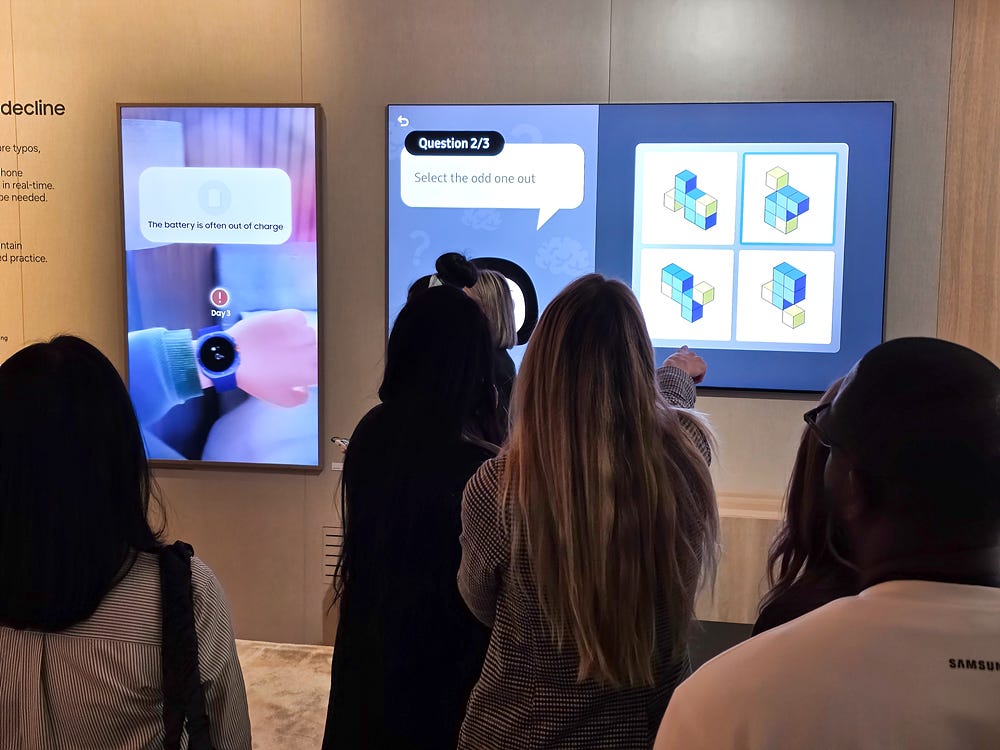
Framed as part of its Family Care vision, the feature monitors patterns most of us never think about—how we walk, how we sleep, how our speech shifts over time—and uses those signals to flag early signs of cognitive decline. If something changes, a caregiver gets notified. If a user wants to act earlier, the system points them toward brain-training exercises. None of this is live yet. Samsung showed it as a concept in clinical validation, not a product on shelves.
That distinction matters. The point isn't Samsung solving dementia detection. It's about shifting where detection begins—from the clinic, where people are seen occasionally, into daily life, where change often appears first.
And this is where it gets real. This is no longer about step count or sleep scores. It is about interpreting whether the way someone lives may be changing in ways that matter. Samsung has committed to processing that data on-device, encrypted through Knox—the same security layer that protects two billion Galaxy devices for governments and hospitals—without sending it to the cloud or external networks.
Brain Health also does not stand alone. It sits inside a broader CES pattern: health moving out of isolated apps and into connected environments. In late 2025, Samsung completed its acquisition of Xealth, a clinical platform spun out of Providence Health that is now embedded in over 500 hospitals—including UPMC, Duke Health, and Mass General Brigham. That gives the ecosystem something most consumer health products lack: a direct line into clinical workflows. The data does not just stay on your watch. It has a path to someone who can act on it.
That bridge between home and clinic is what makes this more than a feature announcement. It is the beginning of a health trust infrastructure.
The real question beneath all of this is whether people are willing to live inside an ecosystem that observes how they move, sleep, and speak in exchange for earlier insight.
That is not a data problem. It is a trust problem.
Why it Matters
Most wearable health tech still ends at the wrist. It collects data, turns it into a chart, and leaves the individual to decide what it means and whether to act. The burden of interpretation and coordination stays with the person already trying to navigate the process.
If you’ve ever spent hours bouncing between disconnected platforms just to schedule a screening or understand your health data, you already know what’s missing.
Samsung is pointing toward something different: a world in which signals do not stop with the individual but can eventually move to someone who can act. That is the larger shift. Not more data. Better flow. And flow only happens when trust is built into the infrastructure from the start.
Millions live with dementia, and earlier pattern recognition in daily life could become part of the answer. Whether that vision succeeds will depend less on the sophistication of the AI than on whether people believe in the infrastructure carrying it.
The lesson for all of us: The next generation of connected health won't be won by the company with the most sensors. It will be won by the companies who people trust enough to let in—because the closer the data gets to real life, the more powerful it becomes.
Make the Human Algorithm Real
This was the hardest issue in the series to write, because trust doesn’t show up the way a product does. You can’t demo it. You rarely notice it when it’s working. You notice it when it breaks.
So make it actionable. Pick one customer workflow and follow the data from beginning to end:
Where does it move?
Who has access?
What control does the human actually have?
Then ask the difficult question: Would your customer be comfortable if they could see exactly what your system does with their data?
Trust isn’t built in talking points. It’s built in what your system proves.
What’s Next
This is Part 4 of The Human Algorithm: Signals from CES—and the final issue in this series with a new series to be announced soon. Across four drivers—Culture & Capability, Tech with Intent, Design for Humans, and Trust as Infrastructure—one pattern stands out: the innovations that mattered were not the loudest. They were the most deliberate. They started with a real human problem and built from there.
We can’t slow the pace of change, but we can decide what we trust.
Trust as Infrastructure reminds us that systems only scale when people believe in how they work.
Let’s build what’s next, together.
— Alyssa
The Human Algorithm is where I explore AI-enabled, human-centered growth for leaders building what’s next. Subscribe on Substack for the series, visit the website for deeper insights, and connect on LinkedIn to stay in the conversation.
Samsung is leading the frontier of health innovation! I've seen a lot of devices and applications that help us track our health but this one is something systematic and 'trust worthy' than other tech. Thank you for sharing this Alyssa.